
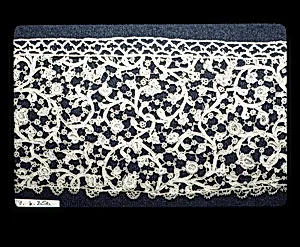
Strip
Unknown Artist
ca. 1700
Medium
Needle lace
Dimensions
L. 40 x W. 3 inches (101.6 x 7.6 cm)
Classification
Textiles-Laces
Culture
Italian, Venice
Department
European Sculpture and Decorative Arts
Museum
Metropolitan Museum of Art, New York, NY
Credit
Anonymous Gift, 1879
Accession Number
79.1.256
Rights
Public Domain
Art Historical Context
Nestled in the Metropolitan Museum of Art's European Sculpture and Decorative Arts, this exquisite *Strip* of needle lace hails from Venice, Italy, around 1700. Measuring 40 inches long by 3 inches wide, this delicate textile exemplifies the city's renowned mastery of lace-making during the Baroque era. Created as an anonymous gift in1879, it invites visitors to marvel at the intricate craftsmanship of an unknown artist from a golden age of Venetian goods. Needle lace, or *punto in aria* ("stitch in air"), was prestigious technique where artisans knotted and looped fine linen threads with a needle to form elaborate, free-form patterns without a supporting ground fabric. Venice dominated this art form in the late 17th and early 18th centuries, producing laces prized across Europe for collars, cuffs, altar cloths, and bridal veils. This strip's slender, elongated form suggests it was designed for garment edging or insertion, showcasing the period's opulent fashion and the labor-intensive skill—often taking months to complete even a small piece. As a cultural treasure, Venetian needle lace symbolized wealth and piety, blending artistry with technical virtuosity. Though anonymous, this survivor highlights how such fragile works preserve Venice's legacy as a hub of innovation and elegance, offering a tactile glimpse into 18th-century refinement.