
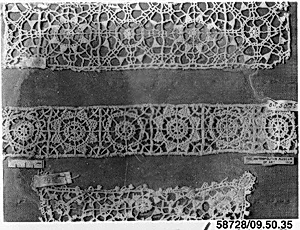
Strip
Unknown Artist
16th–17th century
Medium
Needle lace
Dimensions
L. 8 1/4 x W. 1 1/2 inches (21.0 x 3.8 cm)
Classification
Textiles-Laces
Culture
Italian
Department
European Sculpture and Decorative Arts
Museum
Metropolitan Museum of Art, New York, NY
Credit
Rogers Fund, 1909
Accession Number
09.50.35
Rights
Public Domain
Art Historical Context
This delicate *Strip* of needle lace, crafted by unknown Italian artist in the 16th or 17th century, the pinnacle of Renaissance and Baroque textile artistry. Measuring just 8¼ by 1½ inches, this slender band was likely designed as an edging for garments, collars, or ecclesiastical vestments, where such luxuries signified wealth and piety. Acquired through the Rogers Fund in 1909, it now graces the Metropolitan Museum of Art European Sculpture and Decorative collection. Needle lace, or *punto in aria* ("point in air"), emerged in Italy during the late 16th century as a revolutionary technique. Unlike bobbin lace, which weaves threads on a pillow, needle lace is created stitch by stitch with a needle and thread over a temporary paper pattern, allowing for fluid, sculptural designs that mimic embroidery or even sculpture in fabric. Italian workshops, especially in Venice and Milan, perfected this labor-intensive art, producing pieces that could take months to complete. For visitors, this *Strip* offers a window into Europe's lace mania, when these airy confections adorned nobility from courts to cathedrals. Its preservation highlights the fragility and enduring allure of handmade lace, a testament to anonymous artisans whose skill rivaled the era's greatest painters.