
Strip
Unknown Artist
17th century
Medium
Embroidered net, buratto
Dimensions
L. 16 5/8 x W. 3 3/8 inches 42.2 x 8.6 cm
Classification
Textiles-Laces
Culture
Italian, Abruzzi and Calabria
Department
European Sculpture and Decorative Arts
Museum
Metropolitan Museum of Art, New York, NY
Credit
Rogers Fund, 1909
Accession Number
09.50.2455
Rights
Public Domain
Art Historical Context
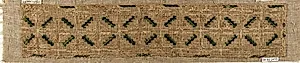
This delicate lace strip, crafted in 17th-century Italy from the Abruzzi and Calabria regions, exemplifies exquisite textile artistry of southern Europe. Measuring 16⅝ × 3⅜ inches (42.2 × 8.6 cm), it is made of embroidered net using the buratto technique—a labor-intensive method where threads are withdrawn from a fabric ground to form a mesh, then meticulously darned and embroidered to create intricate geometric patterns. As a narrow band classified among laces, it likely served as an edging for collars, cuffs, altar linens, or ecclesiastical vestments, blending functionality with opulent decoration. Buratto lace, prominent in Renaissance and Baroque Italy, highlighted the skill of anonymous female artisans in rural workshops, where such pieces were prized for their transparency and durability. Hailing from Abruzzi and Calabria—areas renowned for pastoral lacemaking traditions—this strip reflects the era's fusion of folk craft and high fashion, influenced by trade routes that spread needlework techniques across Europe. Acquired through the Rogers Fund in 1909, it now graces the Metropolitan Museum of Art's European Sculpture and Decorative Arts collection, offering a tactile glimpse into 17th-century domestic and devotional life.