
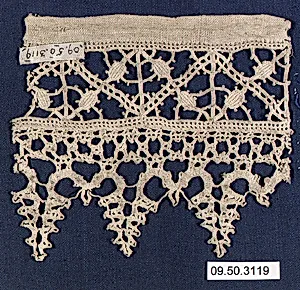
Strip
Unknown Artist
16th–17th century
Medium
Bobbin lace
Dimensions
L. 5 x W. 4 12.7 x 10.2 cm
Classification
Textiles-Laces
Culture
Italian
Department
European Sculpture and Decorative Arts
Museum
Metropolitan Museum of Art, New York, NY
Credit
Rogers Fund, 1909
Accession Number
09.50.3119
Rights
Public Domain
Art Historical Context
This delicate bobbin lace strip, crafted by an unknown Italian artist in the 16th or 17th century, exemplifies the exquisite textile artistry of Renaissance and early Baroque Italy. Measuring just 12.7 x 10.2 cm, it was likely used as a trimming for garments, linens, or furnishings—a common application for such luxury laces. Acquired through the Rogers Fund in 1909, it resides in the Metropolitan Museum of Art's Department of European Sculpture and Decorative Arts, highlighting Italy's pivotal role in lace production during this era. Bobbin lace, distinct from needle lace, is made by twisting and intertwining threads held on handheld bobbins over a patterned pillow secured with pins. This labor-intensive technique allowed for precise, geometric designs and intricate motifs, showcasing the skill of anonymous lacemakers. In 16th–17th-century Europe, Italian bobbin lace from regions like Venice or Milan was highly prized, exported widely, and symbolized wealth and refinement among the elite. As a preserved fragment, this "Strip" offers a window into the technical mastery and cultural prestige of Italian decorative arts. Though small, it reflects how textiles transcended utility to become wearable art, influencing fashion across continents and enduring as a testament to pre-industrial craftsmanship.