
Strip
Unknown Artist
18th century
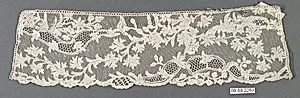
Medium
Bobbin lace
Dimensions
L. 10 1/2 x W. 3 1/2 inches (26.7 x 8.9 cm)
Classification
Textiles-Laces
Culture
Flemish, Brussels
Department
European Sculpture and Decorative Arts
Museum
Metropolitan Museum of Art, New York, NY
Credit
Purchase by subscription, 1909
Accession Number
09.68.226a
Rights
Public Domain
Art Historical Context
This exquisite bobbin lace strip, crafted in 18th-century Brussels, exemplifies the pinnacle of Flemish lace-making artistry. Measuring just 10½ by 3½ inches, this delicate textile strip showcases the intricate patterns typical of Brussels lace, where fine linen threads are twisted and plaited using bobbins—small spools that allow lace makers to create complex motifs with remarkable precision. Produced during the height of Europe's lace mania, when Brussels was a global center for this luxury craft, the piece likely served as an edging for garments, linens, or furnishings, symbolizing wealth and refinement. Bobbin lace, distinct from needle lace, emerged in Flanders in the 16th century and reached its zenith in the 18th, blending technical virtuosity with floral and geometric designs inspired by nature and Baroque opulence. Flemish artisans, often women working in guild-regulated workshops, elevated lace to high art, exporting it across royal courts. This anonymous masterpiece, acquired by subscription in 1909 for the Metropolitan Museum of Art's European Sculpture and Decorative Arts collection, invites visitors to marvel at the patience and skill behind its airy, resilient beauty—a testament to Brussels' enduring lace legacy.