
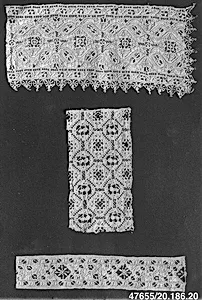
Strip
Unknown Artist
16th century
Medium
Cutwork
Dimensions
L. 14 1/2 x W. 7 inches 36.8 x 17.8 cm
Classification
Textiles-Laces
Culture
Italian
Department
European Sculpture and Decorative Arts
Museum
Metropolitan Museum of Art, New York, NY
Credit
Rogers Fund, 1920
Accession Number
20.186.20
Rights
Public Domain
Art Historical Context
This exquisite 16th-century Italian strip, crafted in the delicate technique of cutwork, exemplifies the Renaissance mastery of textiles as both art and luxury. Measuring just 14½ by 7 inches, this narrow band was likely designed as an edging for collars, cuffs, or ecclesiastical vestments, showcasing the era's obsession with intricate ornamentation. Housed in the Metropolitan Museum of Art's Department of European Sculpture and Decor Arts, it entered the collection via the Rogers Fund in 1920, preserving a fragment of Italy's renowned lacemaking heritage. Cutwork, or *punto tagliato*, involves meticulously cutting away sections of fine linen fabric and securing the gaps with precise needle embroidery or drawn-thread work. This labor-intensive method created airy, geometric patterns that mimicked more advanced needle laces, bridging medieval embroidery traditions with the burgeoning lace industry of the 1500s. Italian artisans, centered in regions like Venice and Milan, elevated cutwork to high fashion, adorning nobility and clergy alike. As a testament to anonymous craftsmanship, this strip highlights how textiles were prized status symbols in Renaissance Europe, blending utility with opulent beauty. Visitors will appreciate its fragility—a reminder of hands that wove threads into enduring elegance over 500 years ago.