
Strip
Unknown Artist
16th–17th century
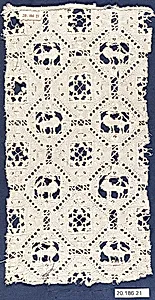
Medium
Cutwork, reticello, punto in aria, linen
Dimensions
L. 9 1/2 x W. 5 inches 24.1 x 12.7 cm
Classification
Textiles-Laces
Culture
Italian
Department
European Sculpture and Decorative Arts
Museum
Metropolitan Museum of Art, New York, NY
Credit
Rogers Fund, 1920
Accession Number
20.186.21
Rights
Public Domain
Tags
Art Historical Context
This exquisite linen lace strip, created by an unknown Italian artist in the 16th or 17th century, the pinnacle of Renaissance-era lacemaking artistry. Measuring just 9½ x 5 inches, it likely served as a decorative border for garments, collars, or furnishings, embodying the opulence of Italy's lace-making tradition centered in regions like Venice and Milan. Delicate animal motifs, hinted at in its design, add a lively, naturalistic touch, reflecting the period's fascination with fauna in decorative arts. The piece masterfully combines advanced techniques: *cutwork* (removing threads to create open patterns stitched with needle), *reticello* (a geometric lace with a net-like ground), and *punto in aria* (free-form "points in air" needle lace built without a foundation fabric). These methods highlight Italian innovators' shift from drawn-thread work to true lace, revolutionizing textiles as luxury goods status symbols for Europe's elite. Housed in the Metropolitan Museum of Art's European Sculpture and Decorative Arts Department (Rogers Fund, 1920), this fragile survivor offers a window into a labor-intensive craft that took skilled nuns and artisans weeks to produce. It reminds us how such textiles blurred art and utility, adorning the powerful while preserving cultural motifs across centuries.