
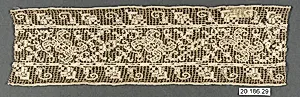
Strip
Unknown Artist
16th century
Medium
Embroidered net
Dimensions
L. 8 3/4 x W. 2 1/2 inches 22.2 x 6.4 cm
Classification
Textiles-Laces
Culture
Italian
Department
European Sculpture and Decorative Arts
Museum
Metropolitan Museum of Art, New York, NY
Credit
Rogers Fund, 1920
Accession Number
20.186.29
Rights
Public Domain
Art Historical Context
This delicate "Strip" of embroidered net lace, crafted by an unknown Italian artist in the 16th century, exemplifies the artistry of Renaissance textiles. Measuring just 8¾ x 2½ inches (22.2 x 6.4 cm), this narrow band was likely designed as an edging for elite garments, such as collars, cuffs, or veils, where fine details could catch the light and showcase wealth. In 16th-century Italy—particularly in lace-making hubs like Venice and Milan—techniques like reticella and early needlepoint lace emerged, transforming simple linen threads into intricate geometric patterns on a net ground. Embroidered net, as seen here, involved painstaking needlework to create openwork motifs, blending embroidery with lacemaking. These pieces were labor-intensive luxuries, symbols of status among nobility and clergy during the opulent Renaissance era. Housed in the Metropolitan Museum of Art's Department of European Sculpture and Decorative Arts (acquired via the Rogers Fund in 1920), this textile strip highlights Italy's pivotal role in Europe's lace revolution, influencing fashion across the continent for centuries. A testament to anonymous artisans' skill, it invites us to appreciate the hidden mastery behind everyday elegance.