
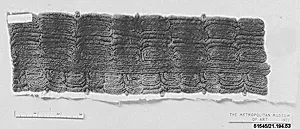
Strip
Unknown Artist
19th century
Medium
Wool on linen
Dimensions
L. 12 1/2 x W. 4 inches (31.8 x 10.2 cm)
Classification
Textiles-Embroidered
Culture
Hungarian or Transylvanian
Department
European Sculpture and Decorative Arts
Museum
Metropolitan Museum of Art, New York, NY
Credit
Administration Fund, 1921
Accession Number
21.194.53
Rights
Public Domain
Art Historical Context
This delicate embroidered strip, titled *Strip*, hails from 19th-century Hungary or Transylvania, regions renowned for their vibrant folk textile traditions. Crafted from wool threads on a linen, it measures a slender 12½ x 4 inches, suggesting its use as a decorative band for clothing, such as sleeve cuffs, hems, or altar cloths in rural households. Acquired by the Metropolitan Museum of Art 1921 through the Fund, it now resides in the European Sculpture and Decorative Arts, highlighting the museum's commitment to preserving everyday artistry. Embroidered textiles like this exemplify the anonymous skill of Central European artisans—often women—who wove cultural identity into fabric. The wool-on-linen technique provided durability and rich colorfastness, ideal for garments worn during festivals or daily life. Patterns likely drew from local motifs, blending floral, geometric, and symbolic elements that conveyed community heritage amid the Austro-Hungarian Empire's turbulent era. Though the artist remains unknown, *Strip* offers a window into Transylvanian-Hungarian craftsmanship, where embroidery served both practical and ritual purposes. Its survival underscores the enduring value of folk art in bridging personal expression and collective history.