
Strip
Unknown Artist
17th–early 18th century
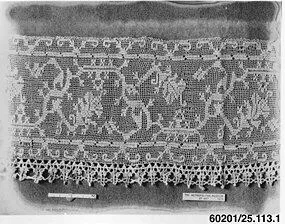
Medium
Embroidered net, buratto,punto à rammendo, bobbin lace
Dimensions
L. 34 x W. 6 1/4 inches 86.4 x 15.9 cm
Classification
Textiles-Laces
Culture
Italian or Spanish
Department
European Sculpture and Decorative Arts
Museum
Metropolitan Museum of Art, New York, NY
Credit
Gift of Mrs. Robert W. de Forest, in memory of Mrs. James Boorman Johnstone, 1925
Accession Number
25.113.1
Rights
Public Domain
Art Historical Context
This exquisite lace strip, crafted by an unknown artist in the 17th to early 18th century, hails from either Italy or Spain, regions renowned for their mastery of intricate needlework during the Baroque era. Measuring 34 inches long and 6¼ inches wide, it exemplifies the opulence of European decorative arts, where lace served as a lavish status symbol adorning collars, cuffs, and altar cloths for the elite. Now housed in the Metropolitan Museum of Art's Department of European Sculpture and Decorative Arts, it was generously gifted in 1925 by Mrs. Robert W. de Forest in memory of Mrs. James Boorman Johnstone. The strip's medium blends embroidered net with specialized techniques like *buratto*—a darning-style embroidery on a gauze-like ground—and *punto a rammendo*, an Italian darning stitch that creates open, geometric patterns mimicking woven fabric. Complemented by delicate bobbin lace, these methods highlight the labor-intensive skill of lacemakers, often women in convents or workshops, who wove threads into airy, floral motifs. Such pieces were not just functional but artistic feats, reflecting the period's fascination with light, texture, and illusion in textiles. Though anonymous, this strip captures the cultural prestige of lace in Mediterranean Europe, where Italian and Spanish innovations influenced global fashion. Visitors will appreciate its fragile beauty, a testament to centuries-old craftsmanship preserved for modern admiration.