
Strip
Unknown Artist
1800–1820
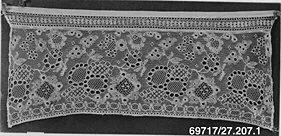
Medium
Bobbin lace
Dimensions
L. 16 x W. 7 inches (40.6 x 17.8 cm)
Classification
Textiles-Laces
Culture
Danish
Department
European Sculpture and Decorative Arts
Museum
Metropolitan Museum of Art, New York, NY
Credit
Gift of Mrs. Schmiegelow, 1927
Accession Number
27.207.1
Rights
Public Domain
Art Historical Context
This exquisite bobbin lace strip, created by an unknown Danish artisan between 1800 and 1820, exemplifies the refined craftsmanship of early 19th-century European. Measuring 16 by 7 inches, it features the intricate patterns characteristic of bobbin lace, technique where threads are wound on bobbins and twisted over a pillow-covered pattern to weave delicate motifs. Unlike needle lace, which uses a single thread and needle, bobbin lace for complex, geometric designs through multiple threads plaited together, showcasing the lacemaker's precision and patience. Hailing from Denmark during the Napoleonic era, this piece reflects a period when lace was a coveted luxury for trimming garments, linens, and furnishings among the elite. Danish lace traditions drew from broader European influences, blending floral and linear elements into elegant borders or insertions like this one. Its cultural significance lies in preserving the skilled handiwork of women artisans, often passed down through generations in rural communities. Now part of the Metropolitan Museum of Art's European Sculpture and Decorative Arts collection—thanks to a 1927 gift from Mrs. Schmiegelow—this strip offers visitors a tactile glimpse into everyday opulence, highlighting how decorative arts elevated the ordinary into art.