
Stucco Fragment
Unknown Artist
probably 8th–12th century
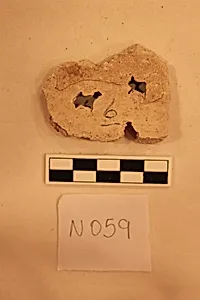
Medium
Stucco; carved and painted
Dimensions
H. 1 15/16 in. (5 cm) W. 1 9/16 in. (4 cm) D. 9/16 in. (1.5 cm)
Classification
Stucco
Department
Islamic Art
Museum
Metropolitan Museum of Art, New York, NY
Credit
Rogers Fund, 1948
Accession Number
48.101.361
Rights
Public Domain
Art Historical Context
This delicate stucco fragment, dating to the 8th–12th century, a glimpse into the refined artistry of early Islamic architecture. Crafted from stucco—a versatile plaster-like material molded and shaped while wet—this tiny piece (just under 2 inches tall) likely adorned a mosque, palace, or residence in regions like Iraq, Iran, or Central Asia during the Abbasid or Seljuk periods. Stucco was prized in Islamic art for its and adaptability, allowing artisans to create intricate decorations on walls and arches where stone carving was impractical. The fragment's carved and painted surface exemplifies sophisticated techniques: skilled hands incised detailed patterns—possibly floral motifs, geometric designs, or calligraphic elements—before applying vibrant pigments for added depth and color. Though worn by time, these methods highlight the era's emphasis on aniconism (avoiding human figures) and mathematical harmony, blending utility with spiritual beauty. Its modest dimensions suggest it broke from a larger frieze, preserving a whisper of opulent interiors that dazzled with light and shadow. Acquired through the Rogers Fund in 1948, this artifact at The Metropolitan Museum of Art underscores stucco's role in democratizing luxury in Islamic culture, inviting us to marvel at the ingenuity of anonymous masters whose work bridged the mundane and the divine.