
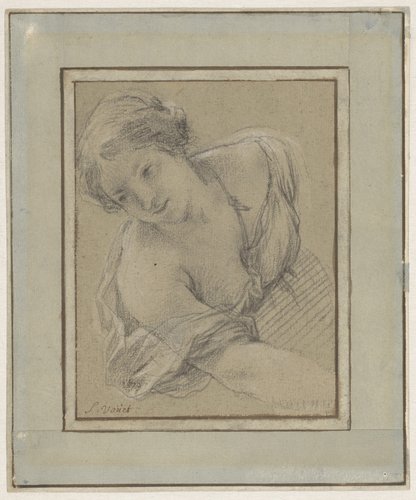
Studie van een buigende jonge vrouw
Simon Vouet, 1600 - 1659
About this artwork
Simon Vouet's *Studie van een buende jonge vrouw* ( of a Bending Young Woman) is a delicate preparatory drawing from the early 17th century, created during the artist's formative years (ca. 1600–1659). Measuring just 172 mm high by 133 mm wide on paper, this intimate sketch captures the fluid motion of a young woman in a graceful, curving pose—likely a study for one of Vouet's grand Baroque compositions. Vouet, a leading French painter who trained in Italy before becoming court artist to Louis XIII, was renowned for his elegant figures and dynamic tenebrism, blending Mannerist grace with emerging Baroque vitality. As a *studio study*, this work exemplifies the meticulous preparatory process of 17th-century artists. Drawn on paper, it would have served as a reference for oil paintings, allowing Vouet to refine anatomy, drapery folds, and contrapposto balance before scaling up. Such drawings were prized in artist's workshops, often circulated among peers, highlighting the collaborative spirit of the era. Vouet's Italian influences, from Caravaggio's drama to classical sculpture, shine through in the pose's rhythmic bend, evoking antique Venus figures. This modest gem offers a window into Baroque draftsmanship's artistry, reminding us how small sketches birthed monumental altarpieces and royal commissions that defined French classicism. A testament to Vouet's skill, it invites viewers to appreciate the hidden labor behind opulent masterpieces.