
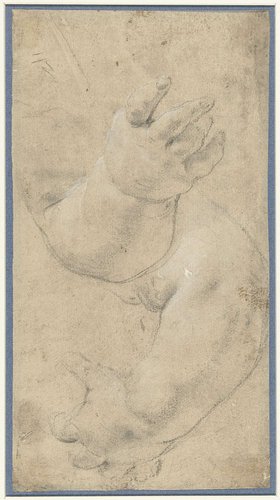
Studie van twee kinderarmpjes
1591 - 1641
Medium
paper
Dimensions
245; 131
Rights
Public Domain
About this artwork
hoogte 245 mm x breedte 131 mm
Art Historical Context
Domenichino (Domenico Zampieri, 1581–1641), a leading figure of the Bolognese School a pupil of the Carracci brothers, was renowned his graceful Baroque paintings blending classical harmony with emotional depth. This delicate drawing, *Studie van twee kinderpjes* (Study of Two Children's Arms), exemplifies his meticulous preparatory sketches, created during his active years from the late 16th to mid-17th century. Measuring just 245 × 131 mm on paper, it captures the tender, rounded forms of infant limbs with Domenichino's characteristic precision, likely as a study for larger frescoes or altarpieces depicting religious or mythological scenes involving children, such as putti or the Christ Child. In the Baroque era, such anatomical studies were essential for artists training in academies, emphasizing naturalistic observation over idealization. Domenichino's drawings, often in black chalk or pen and ink on paper, reveal his debt to Carracci naturalism while foreshadowing his elegant, elongated figures in works like the frescoes at Sant'Andrea della Valle in Rome. This intimate piece highlights the artist's skill in rendering soft textures and subtle modeling, offering visitors a glimpse into the Renaissance-to-Baroque transition where sketches bridged studio practice and grand commissions. Today, such studies hold cultural value as windows into artistic process, collected by connoisseurs for their spontaneity amid Domenichino's polished paintings. A charming reminder of childhood's vulnerability, it invites reflection on how 17th-century masters humanized divine narratives.
About the Artist
Domenichino · 1581–1641
Domenichino was the son of a son of a successful shoemaker. He studied and worked with Ludovico Carracci's studio and under Annibale Carracci. From his frescoes and altarpieces, he was an influential exponent of the 17th-century classical style. Best known for landscapes and for sensitive depictions of facial expression and gestures.