
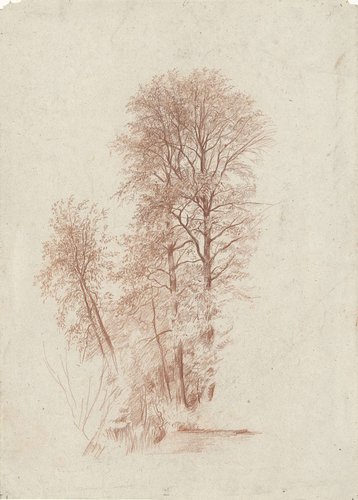
Studie van twee slanke en enige kleinere bomen in blad
1827 - 1878
Medium
paper
Dimensions
235; 340
Rights
Public Domain
About this artwork
height 340 mm x width 235 mm
Art Historical Context
Charles-François Daubigny (7–1878), a leading figure in the Barbizon School of landscape painting, created *Studie van twee sl en enige kleinere bomen blad* ("Study of Two Slender and Some Smaller Trees in Leaf during his prolific career spanning mid-19th century. This intimate drawing on paper, measuring 340 mm high by 235 mm wide, captures Daubigny's fascination with the natural world, particularly the lush foliage and graceful forms of trees along French riverbanks. As a pioneer of plein-air sketching, Daubigny often produced such studies directly from nature, using fluid lines and subtle shading to convey light filtering through leaves. Rendered on paper, this work exemplifies the preparatory sketches that informed his larger oil paintings, blending meticulous observation with poetic realism. It reflects the Barbizon movement's shift away from studio idealization toward authentic rural scenes, influencing later Impressionists like Monet. This modest yet evocative piece invites visitors to appreciate Daubigny's role in bridging Romanticism and modernism, highlighting how simple tree studies embodied a deeper reverence for nature's fleeting beauty in an era of rapid industrialization.
About the Artist
Charles-François Daubigny · 1817–1878
Charles-François Daubigny was born on February 15, 1817, in Paris into a family of artists, with his father, Edmé-François Daubigny, a classical landscape painter, and his uncle, Pierre Daubigny, a miniaturist, providing his initial artistic training. He further studied under Jean-Victor Bertin, Jacques Raymond Brascassat, and Paul Delaroche at the École des Beaux-Arts, though he quickly moved bey...