
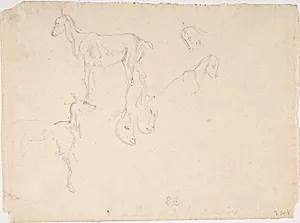
Studies of a Goat
1798–1863
Medium
Graphite on wove paper
Dimensions
6-1/4 x 8-5/8 in. (15.9 x 21.9 cm)
Classification
Drawings
Department
Drawings and Prints
Museum
Metropolitan Museum of Art, New York, NY
Credit
Gift of Elmer Adler, 1925
Accession Number
25.86
Rights
Public Domain
Tags
Art Historical Context
Eugène Delacroix, preeminent French Romantic painter (1798–1863), was renowned for his passionate depictions of nature, emotion, and exotic subjects. *Studies of a Goat*, delicate graphite drawing on wove, exemplifies his meticulous preparatory work. Measuring just 6-1/4 x 8-5/8 inches, this intimate sheet captures the animal's form through quick, expressive sketches—likely from life or memory—revealing Delacroix's keen observation of texture, movement, and anatomy. As a leader of Romanticism, he favored such studies to infuse his grand oil paintings with vitality, bridging the raw energy of nature with artistic drama. Graphite on smooth wove paper allowed Delacroix's fluid lines and subtle shading to shine, techniques honed during his travels and studio practice. These animal studies, including goats, reflect his fascination with the wild and pastoral, echoing themes in masterpieces like *Liberty Leading the People* or North African scenes from his Moroccan journey. Far from mere exercises, they showcase Romanticism's emphasis on spontaneity over classical precision. Today, this gem resides in the Metropolitan Museum of Art's Drawings and Prints department, a 1925 gift from Elmer Adler. It invites visitors to appreciate the artist's hand at its most personal, reminding us that even monumental visions begin with humble sketches.
About the Artist
Eugène Delacroix · 1798–1863
Eugène Delacroix (1798–1863) stands as the defining figure of French Romanticism and a pivotal bridge to modernism. Born in Charenton-Saint-Maurice near Paris, he came from distinguished lineage—his mother descended from the prestigious Oeben-Riesener furniture dynasty, while persistent speculation suggested the statesman Talleyrand may have been his biological father, a theory supported by physic...