
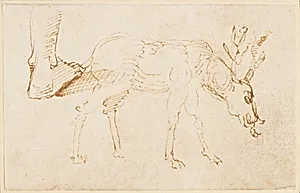
Studies of a Stag
Medium
Pen and brown ink
Dimensions
sheet: 2 11/16 x 4 3/16 in. (6.8 x 10.7 cm)
Classification
Drawings
Department
Drawings and Prints
Museum
Metropolitan Museum of Art, New York, NY
Credit
Harry G. Sperling Fund, 2005
Accession Number
2005.54.2
Rights
Public Domain
Tags
Art Historical Context
In the 1430s, Stefano da Verona (also known as Stefano di Giovanni'Arbosio di Francia a pioneering Veronese painter of the early Italian Renaissance, created this delicate *Studies of a Stag Rendered in pen and brown ink on a sheet measuring just 2 11/16 x 4 3/16 inches (6.8 x 10.7 cm), the drawing captures multiple views of a stag with remarkable precision. Stefano, active in northern Italy during a transitional period from International Gothic to Renaissance naturalism, likely used such studies as preparatory sketches for larger paintings or frescoes, honing his observation of the natural world. The medium of pen and brown ink was ideal for artists like Stefano, allowing fine lines, cross-hatching for shading, and fluid contours that convey the deer's graceful form and textured fur. This intimate scale suggests it came from a personal sketchbook, a practice increasingly valued in the 15th century as painters shifted toward empirical study of anatomy and movement, echoing influences from contemporaries like Pisanello. Housed in the Metropolitan Museum of Art's Drawings and Prints department (acquired via the Harry G. Sperling Fund in 2005), this work highlights Stefano's role in Verona's artistic circle. Stags, symbols of nobility and the hunt in medieval lore, add cultural resonance, inviting visitors to appreciate the quiet artistry behind grand Renaissance masterpieces.