
Studies of Cattle
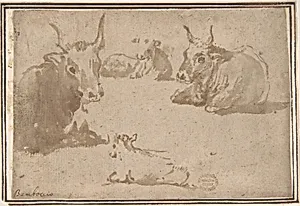
Medium
Brush and brown wash over black chalk on light brown laid paper
Dimensions
4-3/16 x 6-1/4 in. (10.7 x 15.8 cm)
Classification
Drawings
Department
Drawings and Prints
Museum
Metropolitan Museum of Art, New York, NY
Credit
Gift of Cornelius Vanderbilt, 1880
Accession Number
80.3.447
Rights
Public Domain
Tags
Art Historical Context
This delicate 17th-century drawing *Studies of Cattle*, from an anonymous Italian artist of the Roman-Bolognese—a vibrant hub of artistic training in Bologna, influenced by masters like Guercino and Carracci family during the Baroque era. Rendered on light brown laid paper, a common support for preparatory sketches, it captures the sturdy forms of cows with a keen eye for anatomy and movement, reflecting the period's growing emphasis on naturalistic studies from life. The artist employed black chalk for initial outlines followed by fluid brushwork in brown wash to model volume, shadow, and texture. This mixed-media technique was prized for its speed and expressiveness, allowing draftsmen to quickly record observations for larger paintings, frescoes, or engravings—essential in workshops where animal figures enlivened pastoral scenes or allegories of abundance. Housed in the Metropolitan Museum of Art's Drawings and Prints department since Cornelius Vanderbilt's generous gift in 1880, this intimate sheet (just over 4 by 6 inches) offers a window into the everyday rigor of Baroque draftsmanship. Cattle, symbols of fertility and labor in Italian rural life, remind us how such humble studies fueled the grandeur of 17th-century art.