
Studies of Men and a Religious Scene (verso)
1895
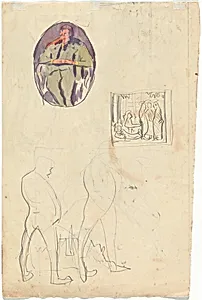
Medium
graphite and watercolor on wove paper, torn from a book
Dimensions
sheet: 31.75 × 21.59 cm (12 1/2 × 8 1/2 in.) irregular
Classification
Drawing
Department
CG-E
Museum
National Gallery of Art, Washington, D.C.
Credit
Bequest of William B. Jordan and Robert Dean Brownlee
Accession Number
2019.45.6.b
Rights
Public Domain
Art Historical Context
Pierre Bonnard's *Studies of Men and a Religious Scene (verso)*, created in 1895, offers a glimpse into the early experimentation of this Post-Impressionist master, who was a key member of the intimate Les Nabis group. At just 28 years old, Bonnard was honing his skills in capturing everyday life and spiritual motifs through quick, expressive sketches. This double-sided drawing, executed in graphite and watercolor on wove paper, reveals his fluid command of mixed media—graphite for precise contours and watercolor for subtle tonal washes—on a sheet irregularly torn from a book, measuring 31.75 × 21.59 cm. Such repurposed supports highlight the artist's spontaneous, improvisational approach during his formative Paris years. The recto features studies of men, likely anatomical explorations or observations from urban life, while the verso depicts a religious scene, blending secular and sacred themes typical of Nabis symbolism. This duality underscores Bonnard's interest in pattern, color, and narrative depth, foreshadowing his later luminous domestic scenes. Bequeathed to the National Gallery of Art by William B. Jordan and Robert Dean Brownlee, the work exemplifies the tactile intimacy of 19th-century drawing practices, inviting visitors to appreciate its raw energy and historical charm.
About the Artist
Pierre Bonnard · 1867–1947
Pierre Bonnard (1867–1947) was a French painter and printmaker who became a leading figure in the Post-Impressionist movement and a founding member of Les Nabis. Born on October 3, 1867, in Fontenay-aux-Roses, France, Bonnard initially studied law at his father's insistence, graduating and briefly practicing as a barrister in 1888. However, his true passion lay in art, and he had simultaneously at...