
Studies of Nudes
n.d.
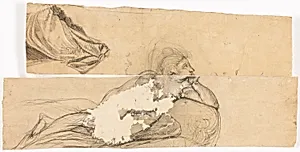
Medium
Black crayon or charcoal heightened with white, on a fragment of tan laid paper, laid down on white Japanese tissue
Dimensions
12.9 × 53 cm (5 1/8 × 20 7/8 in.)
Classification
crayon
Department
Prints and Drawings
Museum
Art Institute of Chicago
Accession Number
159210
Rights
Public Domain
Art Historical Context
Henry Fuseli's *Studies of Nudes* offers a captivating glimpse into the preparatory world of one of the Romantic era's most dramatic artists. Born in Switzerland in 1741 and later thriving in England, Fuseli was renowned for his intense, fantastical depictions of the human form, often drawing from mythology and the supernatural, as seen in his iconic *The Nightmare*. This undated sheet, housed in the Art Institute of Chicago's Prints Drawings department, captures multiple nude figures in dynamic poses across its elongated 12.9 × 53 cm format—a fragment of tan laid paper preserved on white Japanese tissue. Rendered in black crayon or charcoal heightened with white, the work exemplifies Fuseli's mastery of chiaroscuro, where stark contrasts of light and shadow sculpt the bodies with muscular energy and emotional fervor. This technique, rooted in his admiration for Michelangelo, allowed Fuseli to explore anatomy with bold, expressive strokes, pushing beyond classical ideals toward the turbulent spirit of Romanticism. Such studies were vital to his process, fueling larger oil paintings that challenged 18th-century conventions of beauty and restraint. For visitors, this delicate drawing reveals Fuseli's obsession with the nude as a vessel for passion and power, bridging neoclassical precision with proto-Romantic intensity. Its survival as a preserved fragment underscores the fragility of such intimate sketches, inviting us to appreciate the raw origins of artistic genius.
About the Artist
Henry Fuseli · 1741–1825
Henry Fuseli (1741-1825), born Johann Heinrich Füssli in Zürich, was a Swiss-British painter whose visionary works exploring dreams, nightmares, and psychological terror made him one of the most original figures of the Romantic movement. His art bridged Neoclassical discipline with Romantic emotionalism, creating images of supernatural intensity that would influence artists from William Blake to t...