
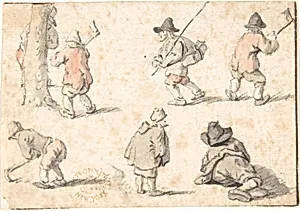
Studies of Peasants
Medium
Black chalk, brush and gray and pink wash. Framing lines in pen and brown ink at top, right, and bottom margins.
Dimensions
2 5/16 x 3 3/8 in. (5.9 x 8.5 cm)
Classification
Drawings
Department
Drawings and Prints
Museum
Metropolitan Museum of Art, New York, NY
Credit
Gift of Cornelius Vanderbilt, 1880
Accession Number
80.3.472
Rights
Public Domain
Tags
Art Historical Context
In the tranquil world of 17th Northern European drawings, *Studies of Peasants* captures the humble grit of rural life. Attributed to Herman Saft II and Jan Bruehel the Elder, this sketch dates to 1625–85, a period bridging Flemish and Dutch artistic traditions. Saftleven, a Dutch master of genre scenes, and Brueghel, famed for his lush landscapes, both drew inspiration from everyday folk, reflecting the era's growing fascination with peasant labor amid the Baroque's dramatic realism. Executed in black chalk with brush and subtle gray and pink washes, plus framing lines in pen and brown ink, the work exemplifies preparatory studies vital to larger compositions. At just 2 5/16 x 3 3/8 inches, its miniature scale invites close inspection, highlighting deft modeling of muscular forms and tools like axes—symbols of toil in agrarian society. These techniques allowed artists to refine anatomy and texture before committing to oil or larger sheets. A cherished gift from Cornelius Vanderbilt to the Metropolitan Museum of Art in 1880, this drawing from the Drawings and Prints department offers a window into the meticulous craft behind Golden Age masterpieces, reminding us how the nobility of labor fueled artistic innovation.