
Studies of Sheep in Pasture
c. 1837/1839
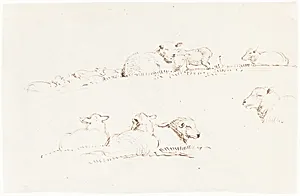
Medium
pen and brown ink on wove paper
Dimensions
overall: 12.1 x 18.7 cm (4 3/4 x 7 3/8 in.)
Classification
Drawing
Department
CG-E
Museum
National Gallery of Art, Washington, D.C.
Credit
Gift of William B. O'Neal
Accession Number
1995.52.145
Rights
Public Domain
Art Historical Context
George Richmond's *Studies of Sheep in Pasture* (c. 1837/1839) is a charming, intimate drawing that captures the artist's keen eye for nature. Rendered in pen and brown ink onove paper, this small-scale work—measuring just 12.1 x 18.7 cm—showcases Richmond's precise line work and subtle shading through hatching and cross-hatching. The British artist (1809–1896), a disciple of William Blake and member of the visionary "Ancients" circle with Samuel Palmer, often explored pastoral themes with a blend of Romantic sensitivity and classical draftsmanship. Created during Richmond's late twenties, likely amid his travels in Italy (1837–1840), the studies depict sheep grazing in a serene pasture, emphasizing their natural poses and textures. Brown ink on smooth wove paper allowed for fluid contours and tonal depth, techniques echoing Renaissance masters Richmond admired. These sketches reflect the era's growing interest in direct observation from life, bridging mystical idealism with emerging realism. A gift to the National Gallery of Art from William B. O'Neal, this drawing highlights Richmond's versatility beyond portraits and biblical scenes. It invites visitors to appreciate the quiet poetry of rural life, preserved in delicate lines that reward close viewing.
About the Artist
George Richmond · 1809–1896
British, Brompton 1809–1896 London