
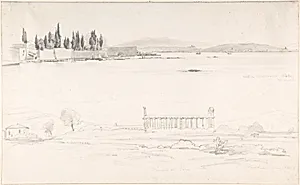
Studies of the Villa Cicerone at the Lago Lucrino near Naples and of the Temple at Paestum (Italy)
mid-19th century
Medium
graphite, framing line in graphite
Dimensions
9-7/8 x 16-1/4 in. (25.1 x 41.3 cm)
Classification
Drawings
Department
Drawings and Prints
Museum
Metropolitan Museum of Art, New York, NY
Credit
Purchase, Sarah and Werner H. Kramarsky Gift and Van Day Truex Fund, 2000
Accession Number
2000.80
Rights
Public Domain
Tags
Art Historical Context
In the mid-19th century, artist Pierre Louis Dubour captured the timeless allure of ancient Italian landscapes in this delicate graphite drawing. Titled *Studies of the Villa Cicone at the Lago Lucrino near Naples and of Temple at Paestum (Italy)*, the work juxtaposes the romantic ruins of Villa Cicerone—linked to the Roman orator Cicero—beside the majestic Doric Temple of Paestum, one of the best-preserved Greek temples from. Measuring 9-7/8 x 16-1/4 inches, it showcases Dubourcq's keen eye for architectural detail amid natural elements like houses, temples, mountains, and trees, evoking the Grand Tour era when European artists flocked to Italy for inspiration. As a preparatory study in the Drawings and Prints department at The Metropolitan Museum of Art, this piece highlights the 19th-century fascination with classical antiquity and the picturesque. Graphite's subtle shading allowed Dubourcq to render textures—from weathered stone to leafy foliage—with precision and lightness, a technique prized for its portability during travels. Acquired through the Sarah and Werner H. Kramarsky Gift and Van Day Truex Fund in 2000, it invites visitors to appreciate how such sketches bridged Romanticism's emotional landscapes with neoclassical reverence for the past.
About the Artist
Pierre Louis Dubourcq · 1815–1873
Dutch, Amsterdam 1815–1873 Amsterdam