
Study
Medium
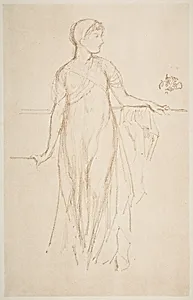
Lithograph with scraping, on a prepared half-tint ground; only state (Chicago); printed in brown ink on grayish wove paper
Dimensions
Image: 10 1/4 x 6 1/2 in. (26 x 16.5 cm) Sheet: 11 1/4 x 8 13/16 in. (28.6 x 22.4 cm)
Classification
Prints
Department
Drawings and Prints
Museum
Metropolitan Museum of Art, New York, NY
Credit
H.O. Havemeyer Collection, Bequest of Mrs. H.O. Havemeyer, 1929
Accession Number
29.107.114
Rights
Public Domain
Tags
Art Historical Context
James McNeill Whistler’s *Study* (1879) is a delicate lithograph that exemplifies the artist’s mastery of subtle tonal effects and his commitment to Aestheticism, prioritizing beauty and harmony over narrative. during a prolific period in Whistler’s career, when he experimented extensively with printmaking after his high-profile libel trial against critic John Ruskin, this captures his innovative approach to light and form. Printed in brown ink on grayishove paper, it measures a modest 10¼ x 6½ inches, inviting intimate contemplation. The medium—a lithograph with scraping on a prepared half-tint ground—is particularly noteworthy. The half-tint ground provided an even mid-tone base, allowing Whistler to scrape away areas for luminous highlights, creating a soft, atmospheric quality akin to his famous nocturnes and etchings. This “only state (Chicago)” variant, one of Whistler’s experimental proofs, showcases his direct, painterly handling of lithography, blurring the line between drawing and print. Tagged with “Women,” it likely evokes the graceful female figures common in his oeuvre, rendered with elegant restraint. Acquired through the H.O. Havemeyer Collection and now housed in the Metropolitan Museum of Art’s Department of Drawings and Prints, *Study* highlights Whistler’s influence on modern printmaking, bridging 19th-century techniques with impressionistic subtlety. A gem for visitors, it reveals how Whistler transformed everyday media into poetry.
About the Artist
James McNeill Whistler · 1834–1903
James Abbott McNeill Whistler (1834-1903) was an American-born painter and printmaker who became a leading figure in the Aesthetic Movement and pioneer of Tonalism and Japonisme. He revolutionized art by championing "art for art's sake" and treating paintings as visual equivalents of musical compositions, titling works as "arrangements," "harmonies," and "nocturnes" to emphasize formal qualities o...