
Study
c. 1719
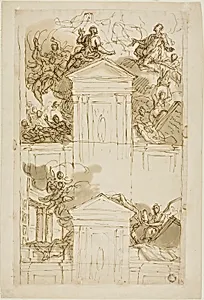
Medium
Pen and brown ink with brush and tan and gray wash on ivory laid paper
Dimensions
32.3 × 20.2 cm (12 3/4 × 8 in.)
Classification
pen and ink drawings
Department
Prints and Drawings
Museum
Art Institute of Chicago
Accession Number
83548
Rights
Public Domain
Art Historical Context
James Thornhill's *Study* (c. 1719) offers a captivating glimpse into the preparatory world of one of England's foremost Baroque artists. Thornhill (1675–1734), knighted by George I and renowned for grand historical murals at St. Paul's Cathedral and the Old Royal Naval College in Greenwich, was a master of illusionistic painting. Created during the height of his career, this drawing exemplifies the meticulous planning behind his large-scale commissions, blending English tradition with Italian Baroque influences from masters like Rubens. Executed in pen and brown ink with subtle brush-applied tan and gray washes on ivory laid paper, the work measures a modest 32.3 × 20.2 cm, ideal for studio use. The technique—precise ink lines for contours and washes for tonal depth—demonstrates Thornhill's skill in modeling form and light, essential for translating sketches to monumental frescoes. Laid paper, with its visible chain lines, was a favored support for such studies in the early 18th century, highlighting the era's advances in printmaking and draftsmanship. Housed in the Art Institute of Chicago's Prints and Drawings collection, this piece underscores Thornhill's pivotal role in elevating British decorative arts. For visitors, it's a window into the artist's hand, revealing the thoughtful process that brought opulent Baroque visions to life.