
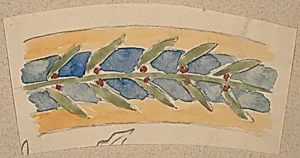
Study for a Border Design
1890/1897
Medium
gouache and graphite on tan wove paper
Dimensions
sheet (irregular): 4.2 × 8.7 cm (1 5/8 × 3 7/16 in.) mount: 30.2 × 46.3 cm (11 7/8 × 18 1/4 in.)
Classification
Drawing
Department
CG-W
Museum
National Gallery of Art, Washington, D.C.
Credit
Gift of Mr. and Mrs. Mark Borghi
Accession Number
1995.24.46
Rights
Public Domain
Art Historical Context
Nestled among the treasures of the National Gallery of, *Study for a Border Design* by Charles Sprague Pearce (1851–1914) offers a glimpse into the meticulous preparatory world of late 19th-century American. Created between 1890 and 1897, this intimate drawing captures Pearce's skill as an expatriate artist trained in Paris, where he embraced academic realism while exploring decorative motifs. At just 4.2 × 8.7 cm on an irregularly cut sheet of tan wove paper, it feels like a secret sketch from an artist's notebook, mounted grandly at 30.2 × 46.3 cm to highlight its delicacy. Pearce employed gouache—an opaque watercolor prized for its vibrant, matte finish—and graphite for precise underdrawings, techniques ideal for designing repeating borders in books, furniture, or murals. Tan wove paper, with its smooth texture and subtle tone, was a favored support for such studies, allowing bold colors to pop against a warm ground. This hybrid medium reflects the era's fusion of fine art and applied design, echoing the Arts and Crafts movement's revival of ornamentation amid industrialization. As a generous gift from Mr. and Mrs. Mark Borghi to the NGA's decorative works collection, this piece underscores Pearce's versatility beyond his renowned genre paintings. It invites visitors to appreciate the hidden labor behind grand designs, reminding us how small sketches birthed enduring beauty in Gilded Age America.
About the Artist
Charles Sprague Pearce · 1851–1914
Charles Sprague Pearce, born on October 13, 1851, in Boston, Massachusetts, grew up in a cultured family immersed in art and exotic imports; his father, Shadrach H. Pearce, ran a business dealing in Chinese porcelain, sparking the young artist's fascination with Eastern motifs. After attending the Brimmer School and Boston Latin School, Pearce worked briefly in the family firm before departing for...