
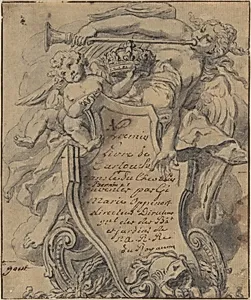
Study for a Cartouche
Medium
Pen and black ink with brush and gray wash. Framing lines in pen and black ink.
Dimensions
5 x 4 3/16 in. (12.7 x 10.7 cm)
Classification
Drawings
Department
Drawings and Prints
Museum
Metropolitan Museum of Art, New York, NY
Credit
Harris Brisbane Dick Fund, 1948
Accession Number
48.4.2
Rights
Public Domain
Tags
Art Historical Context
Gilles-Marie Oppenord, prominent French architect and ornamental designer of the early th century, created this delicate *Study for a Cartouche as a preparatory sketch for an elaborate decorative frame. Cartouches, those scrolling, asymmetrical ornaments often enclosing coats of arms or inscriptions, were hallmarks of the emerging Rococo style—a lighter, more playful evolution from the grandeur of Baroque. Oppenord work bridged the opulent Louis XIV era and the refined Régence period, influencing architecture, furniture, and prints across Europe. Rendered in pen and black ink with subtle brush and gray wash, the small sheet (just 5 x 4 3/16 inches) showcases Oppenord's mastery of fluid lines and tonal modeling. The framing lines in ink neatly bound the composition, typical of draftsmen's precision for scaling up designs. This technique allowed artists to experiment with asymmetry and organic motifs—shells, foliage, and volutes—that defined Rococo exuberance, making architecture feel alive and intimate. Housed in the Metropolitan Museum of Art's Drawings and Prints department, acquired through the Harris Brisbane Dick Fund in 1948, this study offers a window into the creative process behind grand interiors like those at the Hôtel de Massa or Versailles. It reminds us how such humble sketches blossomed into the lavish decorations that adorned salons and facades, embodying the era's love for fantasy and finesse.
About the Artist
Gilles-Marie Oppenord · 1672–1742
Born 27 July 1672; died 13 March 1742. French architect, designer, illustrator, Paris. Comment on works: Architect; Draughtsman; Engraver