
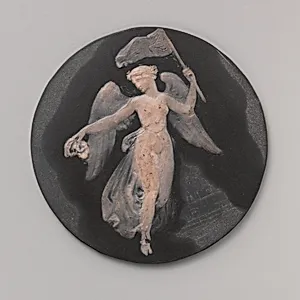
Study for "Flying Victory"
ca. 1830–40
Medium
Wax on slate
Dimensions
Diameter: 2 15/16 in. (7.4 cm)
Classification
Medals and Plaquettes
Culture
British
Department
European Sculpture and Decorative Arts
Museum
Metropolitan Museum of Art, New York, NY
Credit
Gift of Assunta Sommella Peluso, Ignazio Peluso, Ada Peluso and Romano I. Peluso, 2007
Accession Number
2007.490
Rights
Public Domain
Tags
Art Historical Context
William Wyon's *Study for "Flying Victory (ca. 1830–40) is a preparatory work in wax on slate, measuring just under 3 inches in diameter. As a leading British engraver and chief sculptor at the Royal Mint,on mastered the neoclassical style, blending classical motifs with precise realism. This small plaquette captures a dynamic "Flying Victory" figure—likely inspired by the ancient Greek Nike—amid fluttering flags, symbolizing triumph and national pride in an era of British imperial expansion. The medium of wax on slate highlights Wy innovative technique: wax allowed for detailed modeling of fluid drapery and motion before casting in metal for final medals. Common in 19th-century plaquette production, these studies served as prototypes for commemorative pieces honoring military victories or royal events. Its compact scale belies the sculptor's skill, inviting close inspection of textures and symbolism. Housed in the Metropolitan Museum of Art's European Sculpture and Decorative Arts department, this piece was generously gifted in 2007. It offers a window into the meticulous craft behind Britain's numismatic golden age, where art met propaganda in miniature form.
About the Artist
William Wyon · 1795–1851
British, Birmingham 1795–1851 Brighton