
Study for "Gamme mineure" and "Gamme majeure"
1891/1893
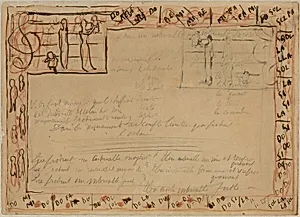
Medium
pen and black ink with red chalk and graphite
Dimensions
overall: 19.6 × 27.4 cm (7 11/16 × 10 13/16 in.)
Classification
Drawing
Department
CG-E
Museum
National Gallery of Art, Washington, D.C.
Credit
Virginia and Ira Jackson Collection
Accession Number
2001.136.35.a
Rights
Public Domain
Art Historical Context
Created in 1891–1893, *Study for "Gammeure" and "G majeure"* is an early preparatory drawing by Pierre Bonnard a founding member of the avant-garde Les Nabis group. At just 24–25 years old, Bonnard was experimenting with Symbolist influences, blending decorative patterns and emotional resonance in his work. This intimate sheet, measuring a modest 19.6 × 27.4 cm, served as a sketch for two paintings evoking musical scales—"minor" and "major"—perhaps symbolizing melancholy and joy through rhythmic lines and forms. Bonnard's mixed-media technique—pen and black ink accented with red chalk and graphite—reveals his masterful control of line and tone. The precise ink outlines contrast with the soft, glowing red chalk highlights, foreshadowing his later luminous color palettes in Post-Impressionist oils. As a drawing from his formative years, it highlights the Nabis' emphasis on flat patterns and suggestion over realism, bridging academic training with modern innovation. Housed in the National Gallery of Art's Virginia and Ira Jackson Collection, this study offers a rare glimpse into Bonnard's creative process, inviting visitors to trace the evolution from sketch to canvas. Its delicate scale and musical theme capture the fin-de-siècle fascination with synesthesia, where sight and sound intertwine.
About the Artist
Pierre Bonnard · 1867–1947
Pierre Bonnard (1867–1947) was a French painter and printmaker who became a leading figure in the Post-Impressionist movement and a founding member of Les Nabis. Born on October 3, 1867, in Fontenay-aux-Roses, France, Bonnard initially studied law at his father's insistence, graduating and briefly practicing as a barrister in 1888. However, his true passion lay in art, and he had simultaneously at...