
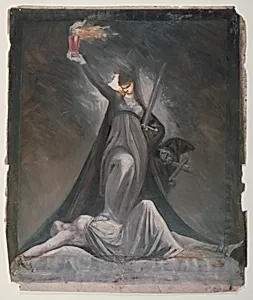
Study for Inquisition, Illustration to Columbiad
c. 1806
Medium
Oil paint, over touches of graphite, on cream wove paper, laid down on stipple etching, etching, and aquatint in black on cream wove paper
Dimensions
52.9 × 44.6 cm (20 7/8 × 17 9/16 in.)
Classification
oil on paper
Department
Prints and Drawings
Museum
Art Institute of Chicago
Accession Number
7577
Rights
Public Domain
About this artwork
The Spanish Inquisition (symbolizing religious intolerance) is personified as a sinister-looking woman carrying a sword and holding a flaming vessel. She stands triumphantly atop the prone body of Truth. Peering out from behind her is a Dominican friar, an instrument of her authority. Fuseli’s painted sketch (a study for an unpublished engraving) illustrates lines from the early American poet Joel Barlow’s Columbiad (published 1807), an epic account in verse of the founding of the United States...
Art Historical Context
Henry Fuseli’s *Study for Inquisition, Illustration to Columbiad* (c. 1806) captures a dramatic moment intended for Joel Barlow’s epic poem * Columbiad*, which recounts the discovery and early history of the Americas. Fuseli, a Swiss-born artist celebrated for his intense Romantic vision and theatrical compositions, explored themes of power, persecution, and human conflict through this preparatory work. The scene evokes the Spanish Inquisition’s shadow over New World exploration, blending historical narrative with emotional intensity characteristic of early 19th-century Romanticism. Created as a mixed-media study, the piece combines oil paint and graphite on paper laid over stipple etching and aquatint. This layered technique reflects Fuseli’s experimental approach, allowing him to refine dramatic lighting and expressive figures before final engraving. Measuring roughly 21 by 18 inches, the work reveals the artist’s process in translating literary drama into visual form. Now housed in the Art Institute of Chicago’s Prints and Drawings department, the study offers visitors a rare glimpse into how Romantic artists bridged painting, drawing, and printmaking to convey complex historical and moral themes.
About the Artist
Henry Fuseli · 1741–1825
Henry Fuseli (1741-1825), born Johann Heinrich Füssli in Zürich, was a Swiss-British painter whose visionary works exploring dreams, nightmares, and psychological terror made him one of the most original figures of the Romantic movement. His art bridged Neoclassical discipline with Romantic emotionalism, creating images of supernatural intensity that would influence artists from William Blake to t...