
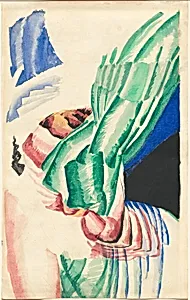
Study for "L'accord des couleurs"
c. 1918
Medium
watercolor over graphite on wove paper
Dimensions
sheet: 48.26 × 30.48 cm (19 × 12 in.)
Classification
Drawing
Department
CG-E
Museum
National Gallery of Art, Washington, D.C.
Credit
Bequest of William B. Jordan and Robert Dean Brownlee
Accession Number
2019.45.16
Rights
Public Domain
Art Historical Context
František Kupka, pioneering Czech artist and one of the unsung heroes of early 20th-century abstraction, created this *Study for "L'accord couleurs"* around 1918. By this time, Kupka had fully embraced non-objective art, influenced byism, Futurism, and his own fascination with color theory and musical analogies. The title evokes the "harmony of colors," reflecting his belief that hues could resonate like notes in a symphony—a radical idea amid the chaos of World War I, when modernism sought new forms of expression beyond representation. Executed in watercolor over graphite on wove paper (48.26 × 30.48 cm), this preparatory drawing showcases Kupka's meticulous technique: faint graphite lines map out fluid, interlocking forms, overlaid with translucent watercolor washes that blend vibrant hues into dynamic abstractions. Such studies were crucial for his larger paintings, allowing experimentation with chromatic balance and spatial rhythm, hallmarks of Orphism—the lyrical abstract style he helped define alongside Robert Delaunay. Now in the National Gallery of Art's collection (CG-E Department, Drawing classification), thanks to the bequest of William B. Jordan and Robert Dean Brownlee, this work invites visitors to trace the birth of pure abstraction. Kupka's innovation reminds us how color alone can evoke emotion and movement, bridging art and science in a timeless visual poem.