
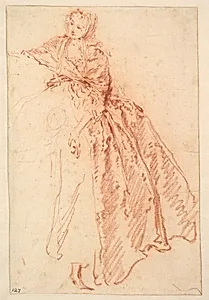
Study for "M. de Pourceaugnac"
early 18th century
Medium
red chalk with touches of graphite
Dimensions
7 11/16 x 5 1/8 in. (19.5 x 13.0 cm)
Classification
Drawings
Department
Drawings and Prints
Museum
Metropolitan Museum of Art, New York, NY
Credit
Gift of Mr. and Mrs. Bruno de Bayser, 2000
Accession Number
2000.91.2
Rights
Public Domain
Tags
Art Historical Context
Jean-Baptiste Joseph Pater, a prominent French Rococo artist and devoted follower of Antoine Watteau, created this delicate *Study for "M. de Pourceaugnac"* in the 18th century. drawing served as a preparatory sketch for scene inspired by Moli's comedic ballet *Monsieur de Pourceaugnac (1669), a satirical play blending music, dance, and farce. Pater's Rococo style shines through in his elegant depictions of figures in theatrical, lighthearted poses, often evoking the playful world of *fêtes galantes*—pastoral gatherings filled with romance and whimsy. This sheet likely captures a female character, highlighting Pater's skill in rendering graceful women amid the era's cultural fascination with commedia dell'arte and Molière's enduring influence on French theater. Executed in red chalk with subtle touches of graphite, the medium was ideal for figure studies, allowing Pater to achieve soft modeling of forms and luminous skin tones that mimic the warmth of life. At just 7 11/16 x 5 1/8 inches, its intimate scale invites close viewing, revealing the artist's swift, expressive lines typical of workshop preparations for larger paintings or tapestries. Red chalk, favored by 18th-century draftsmen like Watteau, offered versatility for both contour and shading, underscoring the technical sophistication of French drawing traditions. Today, this gem resides in the Metropolitan Museum of Art's Drawings and Prints department, a 2000 gift from Mr. and Mrs. Bruno de Bayser. It exemplifies how such studies bridged the gap between imagination and finished works, preserving Pater's legacy as a master of Rococo elegance and offering visitors a window into the vibrant artistic life of Enlightenment France.