
Study for "Poseuses"
1886–87
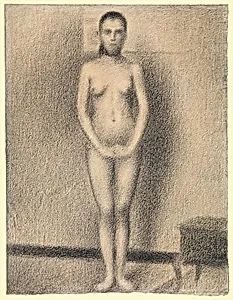
Medium
Conté crayon on laid paper.
Dimensions
11 11/16 × 8 7/8 in. (29.7 × 22.5 cm) Framed: 24 × 18 in. (61 × 45.7 cm)
Classification
Drawings
Department
Robert Lehman Collection
Museum
Metropolitan Museum of Art, New York, NY
Credit
Robert Lehman Collection, 1975
Accession Number
1975.1.704
Rights
Public Domain
Tags
Art Historical Context
Georges Seurat’s *Study for “Poseuses”* offers a fascinating glimpse into the artist’s meticulous creative process. Created between 1886 and 1887, this drawing served as a preparatory work for Seurat’s larger painting *Les Poseuses* (*The Models*), which depicts three nude figures in his studio. As a leading figure of Neo-Impressionism, Seurat was renowned for his innovative pointillist technique in painting, yet his drawings reveal a parallel exploration of form, light, and atmosphere through tonal gradation. Executed in Conté crayon on laid paper, the medium allowed Seurat to achieve velvety textures and subtle transitions of shadow that emphasize the quiet dignity of the female figures. The soft, matte quality of the crayon on textured paper creates a sense of volume and stillness, highlighting the models’ poses without relying on color. Such studies were essential to Seurat’s methodical approach, helping him refine composition and balance before committing to the final canvas. Housed in the Metropolitan Museum of Art’s Robert Lehman Collection, this intimate work underscores the importance of drawing in late nineteenth-century art. It invites viewers to appreciate how Seurat’s careful observation and technical precision shaped modern representations of the human figure.
About the Artist
Georges Seurat · 1859–1891
Georges Seurat (1859-1891) was the founder of Neo-Impressionism and the inventor of Pointillism, a revolutionary technique that transformed how artists understand and apply color. In a tragically brief career cut short at age 31, Seurat produced only seven monumental paintings, yet his systematic application of color theory fundamentally altered the direction of modern art. Born in Paris to a pro...