
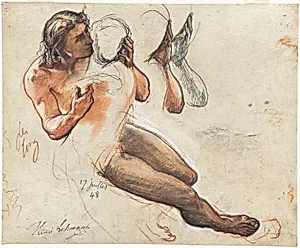
Study for "Rêve d'amour"
1848
Medium
red, black, and white chalk, with stumping, on laid paper
Dimensions
sheet: 25.72 × 31.75 cm (10 1/8 × 12 1/2 in.)
Classification
Drawing
Department
CG-E
Museum
National Gallery of Art, Washington, D.C.
Credit
Bequest of William B. Jordan and Robert Dean Brownlee
Accession Number
2019.45.17
Rights
Public Domain
Art Historical Context
This delicate chalk study by Henri Lehmann, created in 1848, offers a captivating glimpse into the artist’s creative process. Titled *Study for "Rêve d'amour"* (Dream of Love), the drawing served as a preparatory work for a larger composition, allowing Lehmann to explore composition, light, and mood before committing to a final painting. Its intimate scale—just over 10 by 12 inches—invites viewers to appreciate the quiet intensity of the artist’s hand. Lehmann employed red, black, and white chalk with stumping, a technique that softly blends tones to produce subtle gradations and a luminous, almost ethereal quality. This medium was particularly well suited to the dreamy subject matter, enabling gentle transitions that evoke emotion and atmosphere on the laid paper surface. Such drawings highlight the importance of preparatory studies in 19th-century academic practice. Now part of the National Gallery of Art’s collection through the generous bequest of William B. Jordan and Robert Dean Brownlee, the work preserves a tender moment of artistic exploration. It reminds us how even small sketches can reveal the depth of an artist’s vision and the technical skill behind romantic themes.
About the Artist
Henri Lehmann · 1814–1882
French, Kiel 1814–1882 Paris