
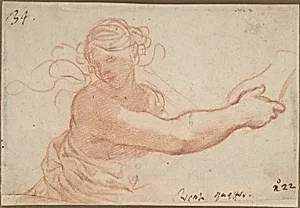
Study for the Allegory of Religion
Medium
Red chalk, glued onto a light cardboard mount.
Dimensions
4 13/16 x 7 1/16in. (12.2 x 18cm)
Classification
Drawings
Department
Drawings and Prints
Museum
Metropolitan Museum of Art, New York, NY
Credit
Rogers Fund, 1964
Accession Number
64.197.3
Rights
Public Domain
Tags
Art Historical Context
Pietro da Cortona (6–1669), a figure of the Roman Baroque, created this delicate *Study for the Allegory Religion* between 1629 and 1639, during his rise as a master of grand fresco cycles and illusionistic decoration. Working in Rome under powerful patrons like the Barberini, Cortona blended classical antiquity with dramatic movement, influencing the High Baroque style. This preparatory drawing captures his fluid approach to allegorical themes, where religion is personified—likely through graceful female figures, as suggested by its tags—symbolizing faith's triumph in an era of Counter-Reformation fervor. Executed in red chalk and glued onto a light cardboard mount, the modestly sized sheet (just 4 13/16 x 7 1/16 inches) exemplifies Baroque drawing techniques. Red chalk's warm tonality allowed artists like Cortona to model forms with subtle highlights and shadows, ideal for sketching drapery and anatomy before transferring to larger frescoes or canvases. Such studies reveal the meticulous planning behind his exuberant compositions, bridging Renaissance precision with Baroque energy. Acquired through the Rogers Fund in 1964, this work from the Metropolitan Museum of Art's Drawings and Prints department offers a rare glimpse into Cortona's creative process. It underscores the cultural importance of allegory in 17th-century art, promoting Catholic devotion through idealized, dynamic imagery that captivated Europe's courts and churches.
About the Artist
Pietro da Cortona (Pietro Berrettini) · 1596–1669
Pietro da Cortona, born Pietro Berrettini on November 1, 1596, in the Tuscan hill town of Cortona, emerged as one of the towering figures of Italian Baroque art, excelling as a painter, architect, and decorator. He received his early training under the Florentine painters Andrea Commodi and Baccio Ciarpi. In 1612, Commodi brought the young artist to Rome, where Pietro immersed himself in the city'...