
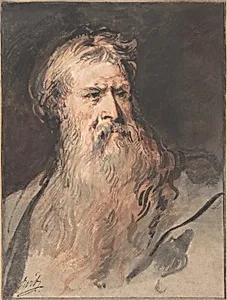
Study for the figure of Moses
1730–37
Medium
Point of brush and black ink with black and gray wash over red chalk
Dimensions
7 11/16 x 5 15/16 in. (19.6 x 15.1 cm)
Classification
Drawings
Department
Drawings and Prints
Museum
Metropolitan Museum of Art, New York, NY
Credit
Purchase, Charles and Jessie Price Gift, 2002
Accession Number
2002.82
Rights
Public Domain
Tags
Art Historical Context
In the heart of the Dutch Enlightenment, Jacob de Wit crafted this intricate *Study for the figure of Moses* between 1730 and 1737. A master of Late Baroque decoration, de Wit was renowned for his grand ceiling paintings and historical scenes adorning Amsterdam's civic buildings, like the Royal Palace. This preparatory drawing captures the prophetic intensity of the biblical Moses, likely intended for a larger altarpiece or fresco, blending classical grandeur with emerging Rococo fluidity. Executed on a modest scale—7 11/16 x 5 15/16 inches—the work showcases de Wit's virtuoso technique: red chalk underdrawing provides a warm foundation, over which fine point-of-brush ink lines define contours with precision. Subtle black and gray washes add volumetric depth, evoking light and shadow to convey Moses' commanding presence. Such studies were essential in the 18th-century workshop, bridging initial sketches to monumental canvases and revealing the artist's meticulous planning. Today, housed in the Metropolitan Museum of Art's Drawings and Prints department (purchased in 2002 via the Charles and Jessie Price Gift), this piece offers visitors a rare glimpse into de Wit's creative process. It humanizes the iconic figure of Moses, tagged here as a portrait study, reminding us how Old Testament heroes inspired Europe's artistic imagination during a time of religious and cultural reflection.
About the Artist
Jacob de Wit · 1695–1754
Comment on works: Religious; Allegory; Bas-relief