
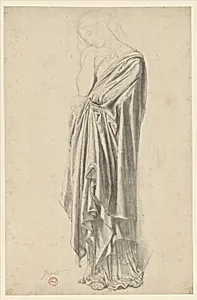
Study for the Figure of Stratonice
Medium
Graphite, black chalk, and rubbed charcoal; some contours incised for transfer
Dimensions
19 7/16 x 12 5/8 in. (49.3 x 32 cm)
Classification
Drawings
Department
Drawings and Prints
Museum
Metropolitan Museum of Art, New York, NY
Credit
Pfeiffer Fund, 1963
Accession Number
63.66
Rights
Public Domain
Tags
Art Historical Context
Jean Auguste Dominique Ingres, master of French Neoclassicism, this exquisite preparatory drawing, *Study for the Figure Stratonice*, between 1834 and 1840. During this period, Ingres served director of the French Academy Rome, where he honed his signature style of precise contours and idealized anatomy, drawing from classical antiquity. The work served as a study for the figure in his monumental painting *Antiochus Stratonice*, which dramatizes the ancient tale of forbidden love between Prince Antiochus and his stepmother Stratonice, by the physician Erasistratus—a story popularized in 18th- and 19th-century art for its emotional and moral depth. Rendered in graphite, black chalk, and rubbed charcoal on a large sheet (19 7/16 x 12 5/8 in.), the drawing showcases Ingres' meticulous technique. Subtle shading builds voluptuous form and soft modeling, while incised contours along key lines allowed for precise transfer to the final canvas—a traditional method underscoring his obsession with perfection. This process highlights Neoclassicism's reverence for line over color, contrasting the looser Romanticism of his contemporaries. Housed in the Metropolitan Museum of Art's Drawings and Prints department, this sheet reveals Ingres' laborious path to timeless beauty, inviting visitors to appreciate the hidden labor behind his polished masterpieces. A celebration of the female form, it bridges ancient myth and 19th-century idealism.
About the Artist
Jean Auguste Dominique Ingres · 1780–1867
Jean-Auguste-Dominique Ingres was born on 29 August 1780 in Montauban, in the Tarn-et-Garonne region of southern France, into a family with deep artistic and musical connections — his father was a painter, sculptor, and musician. He showed exceptional promise from childhood, enrolling at the Académie Royale in Toulouse where he studied under the sculptor Jean-Pierre Vigan, the landscape painter Je...