
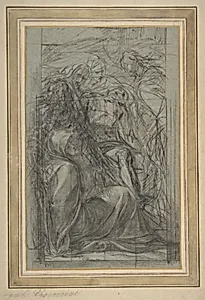
Study for the Pietà
Medium
Charcoal, highlighted with white gouache, squared in charcoal, on blue paper
Dimensions
9 5/16 x 5 7/8in. (23.6 x 15cm)
Classification
Drawings
Department
Drawings and Prints
Museum
Metropolitan Museum of Art, New York, NY
Credit
Harry G. Sperling Fund, 1982
Accession Number
1982.92
Rights
Public Domain
Tags
Art Historical Context
In the early Baroque era, Giulio Cesare Procacc, a prominent Milanese artist from a family of painters and sculptors, created this intimate *Study for the Pietà around 1604. Working in the vibrant Lombard tradition, Procaccini captured the profound sorrow of the Virgin Mary cradling the lifeless Christ—a timeless Christian motif intensified by Counter-Reformation demands for emotional depth and spiritual fervor. This preparatory drawing on blue paper exemplifies the preparatory processes of the time, with charcoal squaring grids allowing the composition to be transferred and enlarged for a larger painting or altarpiece. The medium shines here: charcoal provides rich, expressive shadows, while white gouache highlights dramatically illuminate the figures' forms against the tinted ground, creating a striking chiaroscuro effect. At just 9 5/16 x 5 7/8 inches, its compact scale belies its technical sophistication, revealing Procaccini's mastery in conveying tenderness and pathos through fluid lines and subtle modeling. Housed in the Metropolitan Museum of Art's Drawings and Prints department (acquired via the Harry G. Sperling Fund in 1982), this work offers visitors a rare glimpse into an artist's workshop, bridging the gap between sketch and finished masterpiece in the dawn of Baroque drama.
About the Artist
Giulio Cesare Procaccini · 1574–1625
Painter and sculptor, son of Ercole Procaccini. Having moved to Milan with the rest of the family in the mid-1580s, he trained as a sculptor, perhaps in the workshop of Francesco Brambilla (ii), and then worked (1591–9) for the workshop of Milan Cathedral. Italian painter, printmaker.