
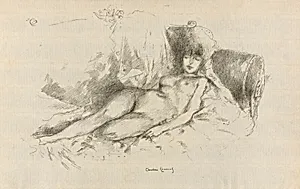
Study from the Nude, Woman Asleep
1890–94
Medium
Transfer lithograph in black on cream laid paper
Dimensions
Image: 16.7 × 24 cm (6 5/8 × 9 1/2 in.); Sheet: 20.5 × 32.4 cm (8 1/8 × 12 13/16 in.)
Classification
lithograph
Department
Prints and Drawings
Museum
Art Institute of Chicago
Accession Number
211083
Rights
Public Domain
About this artwork
The Pettigrew sisters—Hetty, Lily, and Rose—began modeling in their teens, posing first for John Everett Millais and then for Walter Sickert, Philip Wilson Steer, Edward Linley Sambourne, and Hamo Thornycroft. Whistler employed all three sisters for his transfer lithographs in the early 1890s, sometimes along with a child, who has been identified as a Pettigrew niece. Hetty was Roussel’s principal model, seen in his most famous painting, The Reading Girl (1886/87; Tate Gallery).
Art Historical Context
In the hushed intimacy of Theodore Roussel's *Study from the Nude Woman Asleep* (0–94), we encounter a masterful transfer lithograph that captures the serene vulnerability of the female form. Created during the artist's mature period in London, this black-ink work on cream laid paper measures a modest 16.7 × 24 cm, inviting close contemplation. Roussel, an Anglo-French printmaker influenced by James McNeill Whistler and the Aesthetic movement favored such delicate studies to explore light, shadow, and texture with poetic restraint. Transfer lithography, Roussel's chosen technique here, involved drawing on paper with greasy crayon before transferring the image to a lithographic stone—a method prized for its precision and tonal subtlety. This allowed the artist to render the model's softly curving contours and relaxed pose with fluid, almost dreamlike lines, evoking the fin-de-siècle fascination with private, sensual moments amid rapid modernization. Laid paper, with its textured chain lines, enhances the print's vintage charm, grounding it in 19th-century printmaking traditions. Housed in the Art Institute of Chicago's Prints and Drawings department, this rare piece exemplifies Roussel's contribution to the etching and lithography revival, bridging academic nude studies with emerging modernist sensibilities. Visitors are drawn to its quiet elegance, a testament to art's power to distill beauty from repose.
About the Artist
Theodore Roussel · 1847–1926
Theodore Casimir Roussel was born on 23 March 1847 in Lorient, Brittany, France, into a naval family. After serving in the Franco-Prussian War, he began painting in 1872 as an entirely self-taught artist, initially rendering scenes of daily life in the meticulous style of the Old Masters. In 1878, he settled permanently in London, where he immersed himself in the vibrant British art scene. There, ...