
Study: Maud Seated
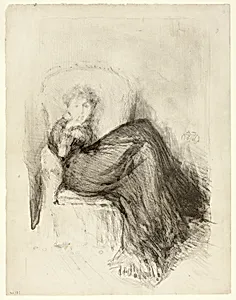
Medium
Lithotint in black ink with scraping and roulette on grayish ivory wove proofing paper
Dimensions
Image: 26.5 × 18.5 cm (10 7/16 × 7 5/16 in.); Sheet: 28.7 × 22.2 cm (11 5/16 × 8 3/4 in.)
Classification
lithotint
Department
Prints and Drawings
Museum
Art Institute of Chicago
Accession Number
139480
Rights
Public Domain
Art Historical Context
James McNeill Whistler, renowned 19th-century artist celebrated for his emphasis on tonal harmony and "art for art's sake created *Study: Maud Seated in 1878. This intimate lithotint captures a seated figure in a delicate, atmospheric pose, exemplifying Whistler's shift toward Aestheticism, where beauty and mood trumped narrative detail. Produced during a prolific period in his printmaking career, following his famous Nocturnes and the Peacock Room controversy the work reflects his experimental spirit amid personal and professional challenges in London. The medium—lithotint in black ink on grayish ivory wove proofing paper—highlights Whistler's innovative mastery of lithography. Unlike standard lithography, lithotint allows for soft, painterly gradations achieved through scraping to lift ink for luminous highlights and roulette, a toothed wheel that imprints fine, textured patterns mimicking fabric or shadow. At just 26.5 × 18.5 cm, this proof-sized study (sheet: 28.7 × 22.2 cm) feels immediate and spontaneous, bridging drawing and painting in print form. Housed in the Art Institute of Chicago's Prints and Drawings department, *Study: Maud Seated* showcases Whistler's influence on modern printmaking, inspiring artists like those in the Symbolist and Art Nouveau movements. Visitors will appreciate its subtle elegance, a quiet testament to how Whistler transformed technical precision into poetic evocation.
About the Artist
James McNeill Whistler · 1834–1903
James Abbott McNeill Whistler (1834-1903) was an American-born painter and printmaker who became a leading figure in the Aesthetic Movement and pioneer of Tonalism and Japonisme. He revolutionized art by championing "art for art's sake" and treating paintings as visual equivalents of musical compositions, titling works as "arrangements," "harmonies," and "nocturnes" to emphasize formal qualities o...