
Study of a Ballet Dancer (recto); Two Studies of Dancers (verso)
ca. 1873
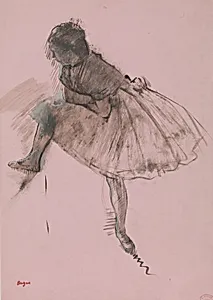
Medium
Oil with opaque watercolor on prepared pink paper (recto); oil on prepared pink paper (verso)
Dimensions
17 1/2 x 12 3/8 in. (44.5 x 31.4 cm)
Classification
Drawings
Department
Robert Lehman Collection
Museum
Metropolitan Museum of Art, New York, NY
Credit
Robert Lehman Collection, 1975
Accession Number
1975.1.611
Rights
Public Domain
Tags
Art Historical Context
Edgar Degas, a master of capturing the grace and toil of modern life, was captivated by the world of ballet throughout his career. Created around 1873, *Study of a Ballet Dancer (recto); Two Studies of Dancers (vers)* showcases his fascination with dancers in motion. On the front, a single ballerina poised in arabesque glows against prepared pink paper, while the features two quick sketches of figures in rehearsal attire. These intimate studies reflect Degas' era, when Paris's Opéra ballet embodied both artistic elegance and the grueling labor of working-class women. Degas innovated with mixed media here: oil combined with opaque watercolor (gouache) on the recto lends luminous depth and vibrant highlights to the dancer's tutu and skin, enhanced by the pink ground that warms flesh tones. The verso's simpler oil sketches demonstrate his efficient use of both paper sides, a practical habit from his studio practice. This double-sided approach reveals the preparatory intensity behind his iconic ballet scenes. Housed in the Metropolitan Museum of Art's Robert Lehman Collection, this 17½ × 12⅜-inch drawing highlights Degas' realist precision amid Impressionist circles—foreshadowing works like his later pastels—while celebrating the cultural allure of 19th-century ballet as a lens on femininity and performance. A window into the artist's process, it invites viewers to appreciate the hidden labors shaping ephemeral beauty.
About the Artist
Edgar Degas · 1834–1917
Edgar Degas (1834-1917) stands as one of the most innovative artists of the nineteenth century, whose distinctive vision transformed how modern life could be depicted on canvas. Born Hilaire-Germain-Edgar De Gas in Paris to a wealthy banking family—his father French, his mother a Louisiana Creole from New Orleans—Degas received a classical education before abandoning law studies in 1855 to pursue ...