
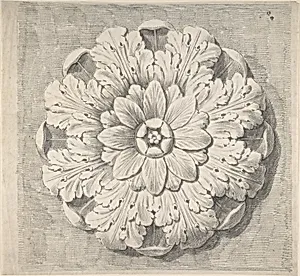
Study of a Classical Rosette
1776–79
Classification
Drawings|Ornament & Architecture
Department
Drawings and Prints
Museum
Metropolitan Museum of Art, New York, NY
Credit
Harris Brisbane Dick Fund, 1934
Accession Number
34.78.2(68)
Rights
Public Domain
Tags
Art Historical Context
Thomas Hardwick’s *Study of a Classical Rosette*, created between 1776 and 1779, exemplifies the neoclassical fascination with ancient ornament during the late eighteenth century. As an architect and draftsman, Hardwick used such studies to analyze decorative motifs from Greco-Roman sources, translating them into designs for buildings and interiors. The rosette—a stylized floral form often carved in stone or stucco—appears here as a delicate, symmetrical bloom, reflecting the period’s renewed interest in classical symmetry and natural detail. Executed as a drawing, the work belongs to the tradition of architectural studies that trained artists and designers in the vocabulary of ornament. Hardwick’s careful rendering highlights the rosette’s layered petals and geometric structure, qualities that would later enrich friezes, ceilings, and moldings in neoclassical projects. Created during years when many British artists traveled to study antique remains, the sheet captures a moment when classical motifs were being meticulously recorded for modern use. Today in the Metropolitan Museum’s collection of drawings and prints, this modest study offers visitors a glimpse into the patient process behind grand architectural decoration, reminding us how small floral forms helped shape the elegant language of eighteenth-century design.