
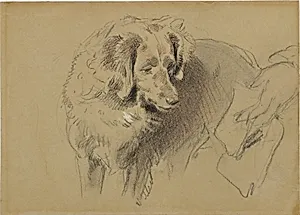
Study of a Dog
1820–73
Medium
Black chalk heightened with white and red chalk
Dimensions
sheet: 6 15/16 x 9 3/4 in. (17.7 x 24.7 cm)
Classification
Drawings
Department
Drawings and Prints
Museum
Metropolitan Museum of Art, New York, NY
Credit
Bequest of Mary Cushing Fosburgh, 1978
Accession Number
1979.135.9
Rights
Public Domain
Tags
Art Historical Context
Sir Edwin Henry Landseer a celebrated British artist of the 19th century was renowned for his vivid depictions of animals, particularly dogs, which he portrayed with remarkable realism and emotional depth. *Study of a Dog*, created between 1820 and 1873, exemplifies his skill in preparatory drawings. Rendered in black chalk heightened with white and red chalk a modest sheet measuring 6 15/16 x 9 3/4 inches (17.7 x 24.7 cm), this intimate work likely captures a dog's form alongside human hands, suggesting interaction or handling—common motifs in Landseer's animal studies that bridged the natural world and human emotion. Landseer's drawings often served as studies for his grand oil paintings, showcasing his mastery of texture and anatomy. The mixed chalk technique allowed for subtle tonal modeling: black for shadows, white for highlights, and red for warm accents, bringing fur and flesh to life with a sculptural quality. This approach reflects the Romantic era's fascination with nature's nobility, where dogs symbolized loyalty and companionship in Victorian Britain. Housed in the Metropolitan Museum of Art's Drawings and Prints department through the 1978 bequest of Mary Cushing Fosburgh, this piece offers a glimpse into Landseer's process, inviting visitors to appreciate the quiet artistry behind his iconic animal portraits.