
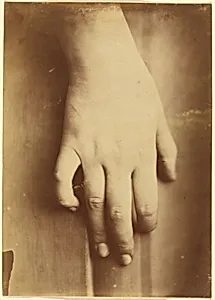
Study of a Hand
Medium
albumen print
Dimensions
image/sheet: 17.3 × 12.3 cm (6 13/16 × 4 13/16 in.)
Classification
Photograph
Department
CPH
Museum
National Gallery of Art, Washington, D.C.
Credit
Patrons' Permanent Fund
Accession Number
1995.36.123
Rights
Public Domain
Art Historical Context
Created in 1865, *Study of a Hand* exemplifies the early artistic and scientific uses of photography during the medium’s rapid development in the nineteenth century. At a time when photographers were exploring the camera’s ability to capture detail beyond human sight, thisen print isolates a single hand, transforming an ordinary subject into an object of careful observation. Such studies often served practical purposes, from anatomical reference for artists and medical professionals to demonstrations of photographic technique. The albumen process itself was revolutionary. Introduced in the early 1850s, it used egg-white emulsion to produce images with rich tonal gradations and fine detail on paper, making it the dominant photographic method until the 1890s. Measuring just 17.3 by 12.3 centimeters, this modest print highlights how photographers used the new technology to record texture, light, and form with remarkable clarity. Now part of the National Gallery of Art’s collection through the Patrons’ Permanent Fund, the work invites viewers to appreciate photography’s emergence as both a documentary tool and an artistic medium.