
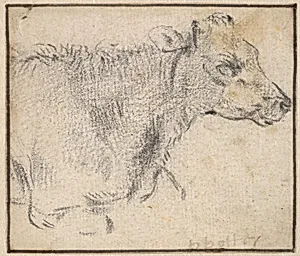
Study of a lying cow
ca. 1650
Medium
Black chalk; framing line in pen and brown ink, by a later hand
Dimensions
Sheet: 2 9/16 × 2 15/16 in. (6.5 × 7.5 cm)
Classification
Drawings
Department
Drawings and Prints
Museum
Metropolitan Museum of Art, New York, NY
Credit
Gift of Paul W. L. Russell, 2013
Accession Number
2013.606
Rights
Public Domain
Tags
Art Historical Context
In the heart of the Dutch Golden Age, Paulus Potter this intimate *Study of a Lying Cow* around 1650, using delicate black chalk on a tiny sheet measuring just 6.5 × 7.5 cm. Potter (1625–1654), a prodigy of animal painting, was renowned for his meticulous depictions of livestock, capturing their serene majesty amid the pastoral landscapes of 17th-century Holland. drawing, now in the Metropolitan Museum of Art's Drawings and Prints department, exemplifies his preparatory sketches—quick yet profound studies that informed his larger oil masterpieces. The medium of black chalk allowed Potter to achieve subtle tonal modeling, rendering the cow's soft fur, relaxed musculature, and gentle curve of its body with lifelike precision. A later framing line in pen and brown ink enhances its presentation, a common practice for preserving such gems. Cows held cultural weight in Dutch society, symbolizing agricultural prosperity and the dairy trade that fueled the era's economic boom. This modest study reveals Potter's genius for anatomy and texture, bridging studio practice with the era's delight in realistic nature. Visitors will appreciate how such small works fueled the Golden Age's celebration of everyday rural life, inviting us to pause and admire the humble beauty of a resting bovine.
About the Artist
Paulus Potter · 1625–1654
Paulus Potter (1625–1654) was a Dutch Golden Age painter whose short life — he died at just twenty-eight years of age — belied an artistic achievement of remarkable originality and influence. Born in Enkhuizen in 1625, Potter trained under his father, the painter Pieter Potter, and later in Amsterdam and Delft, where he absorbed the technical standards of the flourishing Dutch painting tradition. ...