
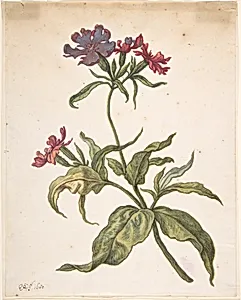
Study of a red catchfly (Lychnis hirsuta)
Medium
Watercolor, gum arabic, and white gouache (oxidized to silver) over black chalk
Dimensions
sheet: 7 13/16 x 6 3/16 in. (19.9 x 15.7 cm)
Classification
Drawings
Department
Drawings and Prints
Museum
Metropolitan Museum of Art, New York, NY
Credit
Purchase, Guy Wildenstein Gift, 2008
Accession Number
2008.46
Rights
Public Domain
Tags
Art Historical Context
Herman Saftleven II a prominent Dutch artist of the Golden Age (1609–1685), created this exquisite *Study of a Red Catchfly (Lychn hirsuta)* in 1680. Known for his lively landscapes and genre scenes,ftleven demonstrated his versatility in botanical drawing, capturing the delicate pink blooms and fuzzy leaves of this wildflower with scientific precision. Such studies reflect the era's fascination with natural history, blending artistic mastery with emerging botanical science in the Netherlands. Rendered on a modest sheet measuring 7 13/16 x 6 3/16 inches, the work employs black chalk for initial outlines, overlaid with translucent watercolor enhanced by gum arabic for vivid intensity. White gouache highlights, now oxidized to a shimmering silver, add luminous depth, mimicking the flower's natural sheen. This mixed-media technique was prized in 17th-century Dutch ateliers for its portability and detail, allowing artists to document flora directly from nature. Acquired by the Metropolitan Museum of Art in 2008 through the Guy Wildenstein Gift, this drawing exemplifies the meticulous observation that influenced later scientific illustration. Visitors will appreciate its timeless charm—a window into Saftleven's keen eye for the beauty in everyday wildflowers.