
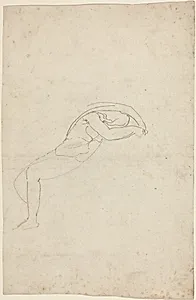
Study of a Semi-Reclining Figure
1751 to 1775
Medium
pen and brown ink over graphite on laid paper
Dimensions
overall: 25.3 x 16.9 cm (9 15/16 x 6 5/8 in.)
Classification
Drawing
Department
CG-E
Museum
National Gallery of Art, Washington, D.C.
Credit
Rosenwald Collection
Accession Number
1980.45.546
Rights
Public Domain
Art Historical Context
This delicate drawing captures a male figure in a semi-reclining pose, leaning forward with his head bowed and arms drawn close to his face. The artist has outlined the contours of the back, shoulders, and legs with fluid lines that reveal the body’s musculature, while subtle shading suggests volume and depth. Executed in pen and brown ink over faint graphite on laid paper, the work shows the economical yet expressive technique typical of a preparatory study, set against the aged, off-white surface of the sheet. John Flaxman created this Study of a Semi-Reclining Figure between 1751 and 1775. A leading figure in British neoclassicism, Flaxman often used such drawings to explore human anatomy and dynamic poses that later informed his sculpture and book illustrations. Now in the Rosenwald Collection at the National Gallery of Art, the sheet offers visitors a glimpse into the artist’s working process and his lifelong interest in the expressive potential of the human form.
About the Artist
John Flaxman · 1755–1826
John Flaxman (1755–1826) was born in York, England, the son of John Flaxman Sr., a moulder and seller of plaster casts who ran a studio in London's Covent Garden. Largely self-taught amid his father's stock of classical casts, with minimal formal schooling due to childhood illness, Flaxman displayed prodigious talent early on. At age 12, he won a Society of Arts prize for a medallion; by 15, anoth...