
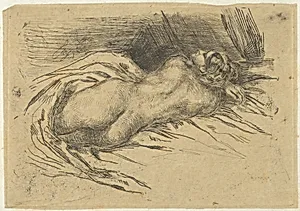
Study of a Woman Viewed from Behind
1833
Medium
Etching on chine collé; second state of four
Dimensions
Plate: 4 7/16 × 6 5/16 in. (11.2 × 16.1 cm) Sheet: 8 7/8 × 12 5/16 in. (22.6 × 31.3 cm)
Classification
Prints
Department
Drawings and Prints
Museum
Metropolitan Museum of Art, New York, NY
Credit
Rogers Fund, 1922
Accession Number
22.60.12
Rights
Public Domain
Tags
Art Historical Context
Eugène Delacroix, a towering figure of French Romanticism, created *Study of a Woman Viewed from Behind* in 1833, capturing the sensual curve of the female form in a intimate rear view. This etching reflects Delacroix's fascination with the human body as a vessel for emotion and movement, hallmarks of the Romantic movement that prized passion over classical restraint. Produced during a prolific period following his transformative 1832 trip to North Africa, the work likely served as a preparatory study, honing his observation of anatomy and light for larger paintings. Rendered in etching on chine collé—a technique where delicate Chinese paper is adhered to a sturdier support for superior ink retention—this is the second state of four, showcasing Delacroix's meticulous refinements, such as softened lines and heightened contrasts. The modest plate size (4 7/16 × 6 5/16 in.) invites close inspection, revealing the artist's virtuoso control of line and tone to evoke texture and volume in the nude figure. Acquired through the Rogers Fund in 1922, this print from The Metropolitan Museum of Art's Drawings and Prints department exemplifies Delacroix's mastery beyond oil on canvas. It offers visitors a glimpse into the private sketchbooks of a genius, celebrating the timeless allure of the female nude in art history.
About the Artist
Eugène Delacroix · 1798–1863
Eugène Delacroix (1798–1863) stands as the defining figure of French Romanticism and a pivotal bridge to modernism. Born in Charenton-Saint-Maurice near Paris, he came from distinguished lineage—his mother descended from the prestigious Oeben-Riesener furniture dynasty, while persistent speculation suggested the statesman Talleyrand may have been his biological father, a theory supported by physic...