
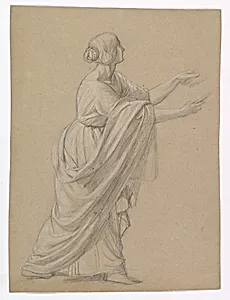
Study of a Woman Walking to the Right
1808–62
Medium
Graphite, white chalk, on light brown paper
Dimensions
sheet: 13 3/4 x 10 9/16 in. (34.9 x 26.9 cm)
Classification
Drawings
Department
Drawings and Prints
Museum
Metropolitan Museum of Art, New York, NY
Credit
Purchase, Alain and Marie-Christine van den Broek d'Obrenan Gift, 2008
Accession Number
2008.632
Rights
Public Domain
Tags
Art Historical Context
Wilhelm Schadow’s “Study of a Woman Walking to the Right” captures a quiet moment of everyday motion with remarkable sensitivity. Created between 1808 and 1862 on light brown paper, the drawing combines graphite with delicate white chalk highlights to model the figure’s form and the subtle play of light across her clothing. This restrained palette allows the artist to focus on the gentle sway of fabric and the natural rhythm of a walking pose, turning a simple figure study into an exercise in grace and observation. As a leading figure of the Nazarene movement, Schadow valued precise line work and careful attention to nature, qualities clearly visible in this sheet. Such preparatory drawings were essential tools for nineteenth-century artists, helping them explore anatomy, drapery, and movement before committing to larger paintings or frescoes. The work’s intimate scale—just under fourteen inches tall—invites viewers to appreciate the quiet skill involved in rendering something as ordinary, yet fleeting, as a woman’s stride. Acquired by the Metropolitan Museum of Art in 2008, the drawing offers a glimpse into the working methods of a pivotal German Romantic artist and reminds us how even the simplest studies can reveal both technical mastery and a deep appreciation for human presence.