
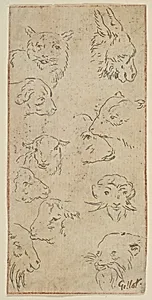
Study of animal heads
n.d.
Classification
Prints
Department
Drawings and Prints
Museum
Metropolitan Museum of Art, New York, NY
Credit
Gift of Michel N. Benisovitch
Accession Number
50.514.16
Rights
Public Domain
Tags
Art Historical Context
Claude Gillot's *Study of Animal Heads* (n.d.) invites visitors into the meticulous world of early 18th-century Frenchmaking. This delicate print from the Metropolitan Museum of Art's Drawings and Prints department captures the expressive heads of goats and sheep rendered with fine lines that highlight their textured fur, alert ears, and soulful gazes. Donated as a gift from Michel N. Benisovitch, it exemplifies Gillot's as an artist who bridged Baroque precision with emerging Rococo lightness. Gillot (167–1722), a pivotal figure in French art, was a skilled engraver and teacher to Antoine Watteau, influencing the fêtes galantes style. While renowned for theatrical scenes from commedia dell'arte, his animal studies like this one showcase his mastery of etching techniques—likely used here for their ability to convey subtle shading and naturalistic detail. These works reflect a growing interest in pastoral motifs, blending scientific observation with artistic whimsy. As a print, this piece held cultural value in an era when such studies served artists, naturalists, and collectors alike, disseminating precise imagery beyond the studio. Its enduring appeal lies in Gillot's ability to infuse humble subjects with lively character, offering a charming glimpse into pre-Revolutionary French draftsmanship.
About the Artist
Claude Gillot · 1673–1722
Artist known for his elegant designs done in the Rococo manner of Audran; also for his predilection for scenes from the 'comedia dell'arte.' Few paintings survive; his work is known mainly through drawings and etchings. Comment on works: Genre; History